



Rear-end collisions are often dismissed as minor accidents, but for some victims, repeated crashes can cause life-altering harm. Nearly four years after recovering $260,000 from a prior rear-end collision, the same client was once again rear-ended while stopped in traffic. This time, the crash caused a traumatic brain injury (TBI) with lasting cognitive and emotional symptoms and significantly aggravated a prior lumbar injury, ultimately requiring spinal fusion surgery. After the insurance company attempted to undervalue the claim, the case was resolved for $735,000 following litigation and aggressive advocacy.
If you are dealing with a rear-end crash involving head trauma, worsening spinal injuries, or an insurance carrier minimizing your claim, this case highlights why UM coverage and experienced legal representation matter. Below is a detailed breakdown of what happened, how the insurance issues unfolded, and why the outcome changed.
Case Snapshot
Total Recovery: $735,000
Type of Crash: Rear-end collision while stopped in traffic
Client: Same client as prior rear-end UM case, approximately four years later
Primary Injuries:
- Traumatic brain injury (TBI)
- Aggravation of prior lumbar injury requiring fusion surgery
Symptoms:
- Persistent head pain
- Memory deficits
- Confusion
- Emotional instability lasting nearly one year
Treatment:
- Occipital nerve blocks
- Hyperbaric oxygen therapy
- Platelet-rich plasma (PRP) therapy
- Other specialized neurological interventions
- Lumbar fusion surgery after failed conservative care
Insurance Issue: Minimal at-fault coverage; UM carrier undervalued the claim
UM Coverage: $1,000,000 policy limit
Outcome: $735,000 settlement after lawsuit filed
What Happened in the Second Rear-End Collision
Nearly four years after his first rear-end crash, our client was again stopped in traffic when another driver struck him from behind. The impact caused immediate and serious consequences.
Unlike the first crash, which primarily involved spinal injury, this collision resulted in a traumatic brain injury. Over the following months, the client experienced ongoing head pain, memory problems, confusion, and emotional instability. These symptoms disrupted daily life, strained personal relationships, and interfered with normal functioning for nearly a year.
At the same time, the collision significantly aggravated his prior lumbar injury, which had previously been managed conservatively. Despite additional non-surgical treatment attempts, the worsening condition ultimately required lumbar fusion surgery, a major procedure with long-term implications.
Traumatic Brain Injury in Rear-End Collisions
TBIs are not limited to high-speed crashes or direct head strikes. Sudden acceleration and deceleration forces in rear-end collisions can cause the brain to move violently within the skull, leading to neurological injury.
In this case, the client’s treatment included advanced and specialized care, such as:
- Occipital nerve blocks to address chronic head pain
- Hyperbaric oxygen therapy to support neurological recovery
- PRP therapy and other interventions aimed at healing and symptom control
These treatments underscore the seriousness of the injury and the prolonged recovery process that followed.
Aggravation of a Preexisting Injury Still Counts
One common insurance defense is to argue that a victim’s condition was “preexisting.” Florida law does not allow insurers to avoid responsibility simply because a person had a prior injury. When a crash aggravates or accelerates an existing condition, the at-fault party and applicable UM carrier may still be responsible for the resulting damages.
Here, the second rear-end collision substantially worsened a known lumbar condition. Conservative measures failed, and surgery became unavoidable. That progression mattered, and it was supported by medical records and treating providers.
Insurance Coverage: Why the Outcome Changed This Time
As with the first crash, the at-fault driver carried only minimal bodily injury insurance. The difference was that this time, the client had increased his UM coverage to $1,000,000.
That decision proved critical.
Despite clear evidence of TBI, extensive treatment, and the need for lumbar fusion surgery, the UM carrier initially offered far less than the claim was worth. The undervaluation followed a familiar pattern, questioning severity, causation, and long-term impact.
Rather than accept an unfair offer, a lawsuit was filed.
Florida’s UM framework is governed by Fla. Stat. § 627.727, which explains how UM coverage applies when the at-fault driver’s insurance is insufficient.
Litigation and Detailed Case Preparation Made the Difference
This case resolved for $735,000 because it was prepared as if it would be tried.
That preparation included:
- Developing a clear medical narrative tying the TBI and spinal aggravation to the crash
- Documenting the full scope of neurological and orthopedic treatment
- Demonstrating how the second crash changed the client’s physical, cognitive, and emotional baseline
- Addressing anticipated insurance defenses regarding preexisting injury
Once the insurer was confronted with the strength of the evidence and the risks of litigation, the case was resolved for a $735,000 settlement.
Why This Case Matters for Florida Drivers
This second settlement reinforces several critical lessons:
- Rear-end collisions can cause serious brain and spinal injuries
- Repeat injuries can dramatically compound long-term consequences
- UM coverage often determines whether full compensation is possible
- Increasing UM limits can make a meaningful difference years later
- Insurance companies may not offer fair value until legal pressure is applied
If you want to understand how Florida law treats rear-end collisions and following distance, Fla. Stat. § 316.0895 outlines drivers’ duties to maintain a safe following distance.
Practical Takeaways After a Rear-End Crash Involving Head or Spine Injuries
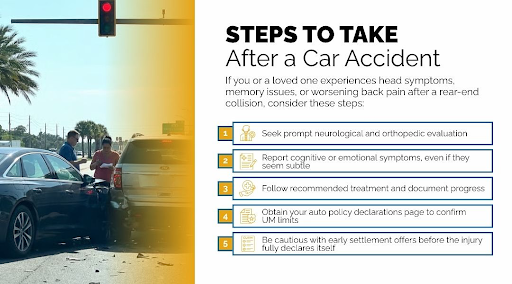
If you or a loved one experiences head symptoms, memory issues, or worsening back pain after a rear-end collision, consider these steps:
- Seek prompt neurological and orthopedic evaluation
- Report cognitive or emotional symptoms, even if they seem subtle
- Follow recommended treatment and document progress
- Obtain your auto policy declarations page to confirm UM limits
- Be cautious with early settlement offers before the injury fully declares itself
Talk With a Sarasota UM Lawyer About Your Rear-End Collision Case
If you were rear-ended and suffered a traumatic brain injury, spinal injury, or aggravation of a prior condition, and the insurance company is minimizing your claim, guidance from an experienced Sarasota car accident lawyer can make all the difference.
Call Dannheisser Injury Law at 941-365-7600, complete our online contact form, or start a live chat on our website to discuss your situation. We are ready to review the facts, explain your options, and help you pursue the recovery you deserve.


